The aurora australis, or southern lights, is a glow in the night sky caused by charged particles from the Sun striking gases high in the atmosphere. In Australia it is seen most often from Tasmania, and during stronger geomagnetic storms from the coasts of Victoria, South Australia and south-west Western Australia, always looking south from a dark spot. The Bureau of Meteorology's Space Weather Forecasting Centre issues free aurora outlooks, watches and alerts, and the Kp index tells you how far north the display may reach.
- Look south from a dark place with a clear southern horizon, ideally away from city lights.
- Kp 3 to 4: Tasmania. Kp 5: the Victorian coast. Kp 6: the south-west coast of WA. Kp 7 and above: southern NSW and further north.
- The Bureau's Space Weather Forecasting Centre issues aurora outlooks (3 to 7 days ahead), watches (up to 48 hours) and alerts (happening now).
- The May 2024 storm reached G5, the first of that strength since October 2003, and lit up skies across southern Australia.
- Solar cycle 25 peaked in October 2024, but strong storms can still happen as activity declines.
For most of us the aurora australis used to be something you saw in a calendar photo from Tasmania. Then came May 2024, when phones across Melbourne, Adelaide and Perth suddenly filled with pink and green skies. If that night has you hooked, this guide covers what the southern lights are, where in Australia you can see them, how to use the Bureau of Meteorology's aurora forecasts, and how to get a decent photo.
What is the aurora australis?
The Sun constantly streams charged particles into space, the solar wind. When a burst of that material reaches Earth, usually from a coronal mass ejection (CME) or a fast stream from a coronal hole, it shakes up Earth's magnetic field. That disturbance is a geomagnetic storm. Energetic particles are funnelled down towards the poles, where they collide with oxygen and nitrogen roughly 100 to 300 km up and make them glow.
The glow forms a ring around each magnetic pole called the auroral oval. In the north it's the aurora borealis, or northern lights. In the south it's the aurora australis. The stronger the storm, the further the oval expands towards the equator, and that's when Australians get a look.
Why the colours look different on camera
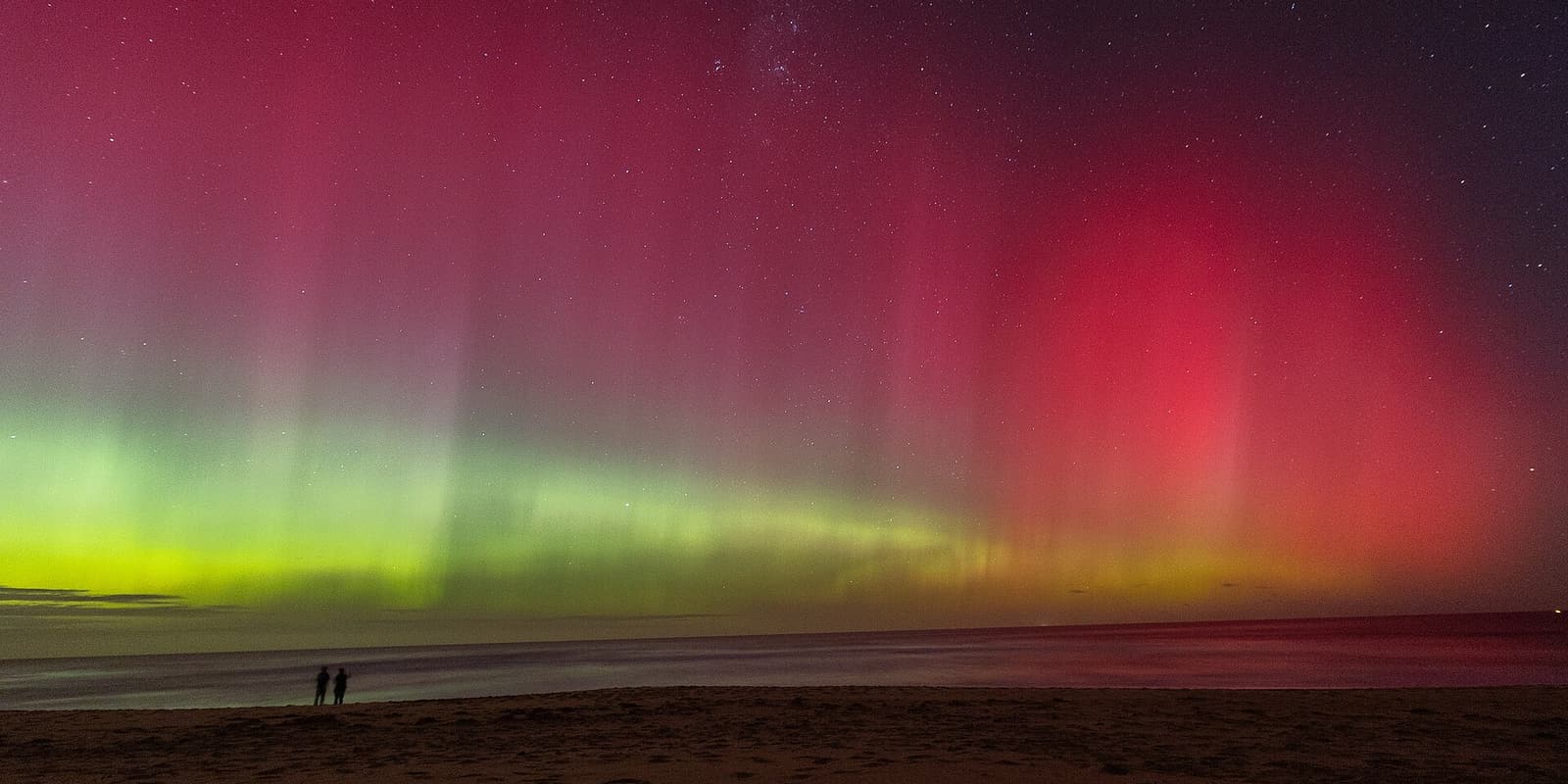
Green is the classic aurora colour, from oxygen in the lower part of the display. Oxygen higher up glows red, and nitrogen adds blue and purple. From the mainland you're usually looking at the top of a distant aurora, so red and pink often dominate low on the southern horizon. Your eyes are poor at seeing colour in the dark, which is why a display that looks like a pale grey-white glow to you can look vivid on a phone screen.
Where to see the aurora australis in Australia
The rule is simple: get as far south as you can, find somewhere dark, and look south over an unobstructed horizon. The ocean is ideal.
- Tasmania. The best place in Australia by a long way. Around Hobart, dark spots on the South Arm peninsula, Bruny Island and the far south give a clear view south. On the east coast, Bicheno looks out over open water, and the west coast around Strahan is very dark.
- Victoria. The south coast faces Bass Strait. Popular spots include Point Lonsdale, the Mornington Peninsula, Phillip Island, Inverloch and the Great Ocean Road around Apollo Bay.
- South Australia. Head to the south coast of the Fleurieu Peninsula around Victor Harbor, or the Limestone Coast near Robe.
- Western Australia. The south coast from Albany to Esperance has dark skies and a clear southern horizon.
How far north can it reach? The Kp guide
The Bureau's Space Weather Services publishes this rough guide to the northern limit of visibility for each level of the planetary K index (Kp).
| Kp | Geomagnetic activity | Northern limit of visibility |
|---|---|---|
| 3 | Unsettled | Southern Tasmania |
| 4 | Active | All of Tasmania |
| 5 | Minor storm | Coastline of Victoria |
| 6 | Major storm | South-west coast of Western Australia |
| 7 | Severe storm | Southern New South Wales |
| 8 | Severe storm | Southern Queensland |
| 9 | Severe storm | The tropics |
Treat these as best-case figures for dark, clear skies. At the northern edge you will usually see a low glow rather than dancing curtains overhead.
How to read an aurora forecast: Bureau alerts, watches and the Kp index
The Bureau of Meteorology runs the Australian Space Weather Forecasting Centre, which issues three kinds of aurora notice. You can subscribe to them by email for free.
- Aurora Outlook: 3 to 7 days' notice, issued when a large active region on the Sun is rotating into a position where a CME could head our way, or for a significant coronal hole. These are infrequent.
- Aurora Watch: up to 48 hours' notice, issued after a significant CME or coronal hole is likely to affect Earth. Alerts follow if the activity eventuates.
- Aurora Alert: activity favourable for aurora is happening now. The alert names the latitude band where aurora may be visible: high, middle, low or equatorial.
A high latitudes alert is mostly good news for Tasmania. A mid latitudes alert is when mainland viewers should get out of the house.
The Bureau's aurora page also shows the K index, a measure of geomagnetic activity over a three-hour period. The Australian-region figure (K aus) is recalculated about every five minutes, while the planetary Kp from the US NOAA is updated every three hours. All alert times are in Universal Time, so add 10 hours for AEST or 11 hours for AEDT.
Weather matters as much as space weather. An aurora alert is useless under thick cloud, so check the hourly forecast for Hobart or your own town for cloud cover, and the Tasmania forecast page for the bigger picture.
The great displays of May and October 2024
May 2024. A sequence of CMEs left the Sun on 8 and 9 May. When they arrived, the Australian Space Weather Forecasting Centre reported that planetary geomagnetic conditions reached G5, the top of the scale, between 2100 UT on 10 May and 0300 UT on 11 May. It was the first G5 storm since October 2003. Over that weekend aurora was seen and photographed across southern Australia, including from Melbourne beaches, as in the photo on this page.
October 2024. The Centre issued an Aurora Watch on the morning of 10 October (AEDT), warning a CME was expected within 48 hours. It then issued mid-latitude aurora alerts early on 11 October and again that evening, and many people across the south of the country got a second big show in the same year.
Solar cycle 25: is aurora season over?
The Sun's activity rises and falls over a cycle of roughly 11 years, measured by the number of sunspots. NASA and NOAA announced on 15 October 2024 that the Sun had reached the solar maximum period of cycle 25. The Belgian solar data centre SIDC has since confirmed that the smoothed sunspot number peaked in October 2024, at about 161, and that activity has been gradually declining.
That doesn't mean the show is over. Strong storms often come on the way down from a maximum: the G5 storm of October 2003, the last before May 2024, arrived well after the previous cycle had peaked. Expect fewer big nights in 2026 and 2027 than in 2024, but keep the alerts switched on.
Tips for seeing and photographing the southern lights
Seeing it
- Get away from streetlights and town glow. Even 20 minutes' drive out of a city makes a big difference.
- Let your eyes adapt for 15 to 20 minutes and use a red torch.
- Moonlight washes out faint aurora, so nights near the new moon are better.
- Winter has the longest nights, which gives you more hours of darkness, but aurora can happen in any month. Our guide to sunrise, sunset and daylight saving helps you work out when it gets properly dark.
- Dress for it. A clear night on the Victorian or Tasmanian coast can be cold and windy at any time of year. Check the Melbourne hourly forecast before you head out.
Photographing it
- Phone: use night mode, brace the phone against something solid or use a small tripod, and point it south. Phones often reveal aurora you can barely see.
- Camera: use a tripod, a wide lens at its widest aperture, focus manually on a bright star, and start with an exposure of around 5 to 15 seconds at ISO 1600 to 3200. Shorten the exposure if the aurora is bright and moving fast.
- Composition: a foreground such as a jetty, rocks or people on a beach turns a pink smudge into a photo worth keeping.
Leave the car lights off when you arrive at a viewing spot, since others will be shooting long exposures. And if you're not sure what season or how much darkness you're working with, our guide to seasons in Australia has the solstice dates.
Common questions
Can you see the aurora australis from Melbourne?
Yes, on nights of strong geomagnetic activity. The Bureau's guide puts the Victorian coastline in range at around Kp 5, and Melbourne was treated to bright displays in May and October 2024. City light washes out faint aurora, so head to a dark spot with a view south over Bass Strait or Port Phillip, such as the Mornington Peninsula, Point Lonsdale or Phillip Island.
What time is the aurora australis visible?
Any time it's properly dark, once twilight has ended, if a geomagnetic storm is underway. Displays often peak in the hours either side of local midnight, but bursts can come early in the evening or before dawn. Bureau alerts are timed in Universal Time (UT): add 10 hours for AEST or 11 for AEDT.
Can you see the aurora australis from Sydney?
Only rarely. Sydney needs a severe storm, roughly Kp 7 or more, which the Bureau's table links to aurora reaching southern New South Wales. Even then it's usually a low red glow on the southern horizon that a camera picks up better than your eyes, so get away from the city lights, for example to a dark headland south of Sydney looking out to sea.
Why is the aurora australis red or pink?
The colour depends on which gas is glowing and how high. Oxygen low in the aurora gives the common green, while oxygen higher up glows red, which is why a distant aurora seen from mainland Australia often looks red along the horizon. Nitrogen adds blues and purples, and a mix can look pink, especially on camera.
How long does an aurora last?
A display can last from a few minutes to several hours, coming and going in waves as the solar wind changes. A big geomagnetic storm can bring aurora on more than one night: in May 2024 and October 2024 Australians saw displays on consecutive nights. If the alert is still current, it's worth staying out or checking again later.
Is the aurora australis rare in Australia?
Faint aurora is seen from southern Tasmania quite often, especially around solar maximum. Displays bright enough to see from the mainland are much less common and depend on strong geomagnetic storms, which happen a few times a year at best near the peak of the solar cycle and less often at other times.