Ocean temperatures around Australia range from about 31 °C off Darwin in the build-up to about 11 °C in Port Phillip Bay in midwinter. Sydney's sea typically sits around 23 to 24 °C in February and March and drops to about 19 °C from July to September, while the Gold Coast stays above 21 °C all year and Hobart rarely gets past 17 °C. The warmest water arrives in late summer, not December, because the ocean takes months to heat up.
- Sydney: about 24 °C in February, 19 °C in August and September.
- Gold Coast and Noosa: warm enough for most swimmers all year, 22 to 27 °C.
- Perth peaks in March at about 23 °C, helped by the Leeuwin Current in autumn.
- Port Phillip Bay swings from about 21 °C in summer to 11 °C in winter; Hobart stays between 13 and 17 °C.
- Tropical stinger season runs November to May in Queensland and October to May in the Northern Territory.
Ask ten people at Bondi in November how warm the water is and you'll get ten answers, most of them involving the word "fresh". The ocean around Australia covers a huge spread of temperatures, from bathwater in the Top End to the bracing water of southern Tasmania, and it changes far more slowly than the air. Here is what to expect, month by month, and why the east and west coasts behave so differently.
What is the ocean temperature around Australia?
The quick answer is that it depends on latitude, the season and two big ocean currents. Tropical waters off Darwin and Cairns stay between about 24 and 31 °C all year. The subtropical east coast, from Noosa down to the Gold Coast, rarely drops much below 22 °C. Sydney and Perth swing between about 19 and 24 °C. Adelaide, Melbourne and Hobart are cool-water cities, where the sea struggles to reach 21 °C even in February.
The sea also lags the air by about two months. The longest day is in December, but in the south the ocean keeps warming until February or March, and keeps cooling until August or September. That is why an early-December swim in Sydney can feel colder than a cool day in April.
Sea temperature by month: Sydney, Perth, Melbourne and more
The table shows typical average sea surface temperatures, rounded to the nearest degree, for the waters off each place. They are long-term averages drawn from satellite records, not a forecast. Water right at the shoreline can be a degree or two warmer on a still, sunny afternoon and colder after strong winds or heavy rain. For today's reading, use the live water temperature on our beaches page.
| Place (°C) | Jan | Feb | Mar | Apr | May | Jun | Jul | Aug | Sep | Oct | Nov | Dec |
|---|---|---|---|---|---|---|---|---|---|---|---|---|
| Darwin | 31 | 30 | 30 | 30 | 29 | 27 | 26 | 26 | 28 | 30 | 31 | 31 |
| Cairns, Great Barrier Reef | 29 | 29 | 28 | 28 | 26 | 25 | 24 | 24 | 25 | 26 | 28 | 29 |
| Gold Coast | 26 | 27 | 26 | 26 | 24 | 23 | 22 | 22 | 22 | 23 | 25 | 26 |
| Sydney | 23 | 24 | 24 | 23 | 21 | 20 | 19 | 19 | 19 | 19 | 21 | 22 |
| Perth | 22 | 23 | 23 | 23 | 22 | 21 | 20 | 19 | 19 | 19 | 19 | 21 |
| Adelaide (Glenelg) | 20 | 20 | 20 | 19 | 17 | 15 | 14 | 14 | 14 | 15 | 17 | 19 |
| Melbourne (Port Phillip, St Kilda) | 21 | 21 | 20 | 18 | 15 | 13 | 11 | 11 | 12 | 15 | 17 | 19 |
| Hobart | 16 | 17 | 16 | 15 | 15 | 14 | 13 | 13 | 13 | 13 | 14 | 16 |
Sources: monthly averages published by seatemperature.org (Port Phillip figures from seatemperature.info). Values are typical averages and vary from year to year.
Sydney and the NSW coast
Sydney's water peaks at about 24 °C in February and March and bottoms out at about 19 °C from July to September. The swing is small because the East Australian Current keeps feeding warm water down the coast. The catch is upwelling: northerly and north-easterly winds, which are most common in spring and summer, push surface water offshore and let cold water rise from below. After a run of nor'easters, beaches such as Bondi, Manly and Cronulla can suddenly be several degrees cooler than the table suggests.
Gold Coast, Noosa and south-east Queensland
The Gold Coast averages 27 °C in February and still about 22 °C in winter. Surfers Paradise and Noosa Heads are swimmable year-round for most people without a wetsuit, though early-morning winter surfers often wear a thin spring suit for the wind chill rather than the water.
Perth and the west coast
Perth's sea is a little different. It peaks later, at about 23 °C in March, and holds above 21 °C into June, which surprises visitors used to the east coast. The coolest water, around 19 °C, comes in spring, from August to November. Cottesloe and Scarborough are at their best in late summer and early autumn, before the winter storms.
Adelaide, Melbourne and Hobart
These are the cool-water capitals. Gulf St Vincent off Glenelg is shallow, so it warms to about 20 °C in summer but drops to 14 °C in winter. Port Phillip Bay swings even further, from about 21 °C in February to 11 °C in July and August, so a summer dip at St Kilda is pleasant while a midwinter one is a dare. Hobart's water ranges from about 13 to 17 °C, so even in February a swim at Kingston Beach or Seven Mile Beach is short and invigorating.
Cairns, the Great Barrier Reef and Darwin
Cairns and the reef sit between 24 and 29 °C, with the coolest water from June to August, which also happens to be the dry season. Darwin is the warmest city water in the country, averaging around 31 °C from November to January. The trouble in the tropics is not the temperature but what lives in the water, which we cover below.
Why the east coast is warmer: the East Australian Current
The East Australian Current is a warm, southward-flowing current that carries Coral Sea water down the east coast, and it is the largest ocean current close to the Australian shore. It is why the sea off Sydney stays at about 19 °C in winter, while Adelaide, at a similar latitude, drops to 14 °C.
The current is not a neat conveyor belt. It meanders and throws off large warm eddies into the Tasman Sea, which can sit off the NSW coast for weeks and push local water temperatures several degrees above average. When an eddy parks off Sydney in late summer, the water can feel tropical. When it moves away and the nor'easters start up, it can turn cold within a couple of days.
Why the west coast is warm in autumn: the Leeuwin Current
Western Australia has its own unusual current. The Leeuwin Current runs south along the edge of the continental shelf, carrying warm tropical water down the west coast and then east around Cape Leeuwin. That is rare: most continents have a cold current on their west coast. According to the WA Government's fisheries scientists, the Leeuwin Current is strongest in autumn and winter, roughly April to August, and it is responsible for the coral reefs of the Houtman Abrolhos Islands, at about 29° south.
The practical effect for swimmers is that Perth's sea stays warmer for longer into autumn than you would expect, and the coolest water arrives in spring. The current's strength varies from year to year and is linked to El Niño and La Niña: it tends to be stronger in La Niña years and weaker during El Niño.
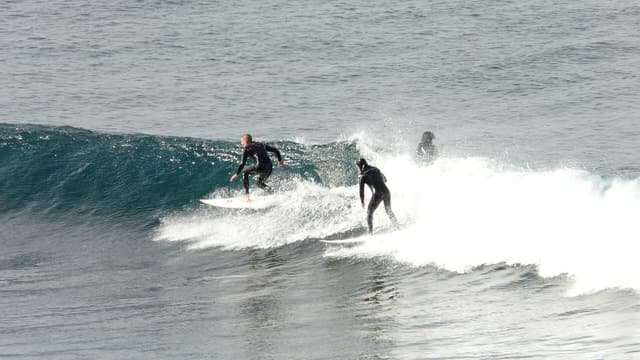
When to wear a wetsuit
There is no official rule, but surfers and ocean swimmers use a fairly consistent rule of thumb:
- Above about 22 °C: boardshorts, swimmers or a rash vest. Gold Coast, Noosa and the tropics most of the year; Sydney and Perth in late summer.
- About 19 to 22 °C: a spring suit or 2 mm top for longer sessions. Sydney and Perth in winter and spring.
- About 15 to 19 °C: a 3/2 mm full steamer. Port Phillip in spring and autumn, Adelaide for much of the year, Hobart in summer.
- Below about 15 °C: a 4/3 mm steamer, often with boots. Port Phillip and Gulf St Vincent in winter, Tasmania for most of the year.
Wind matters as much as the water. A 20 °C sea with a cold southerly change blowing at 30 km/h feels far colder than the number on the beaches page suggests. Sun matters too: on a clear day in the water, the UV is often Very High even when the water feels cold, so check the UV index guide before a long session.
Marine stinger season in the tropics
In tropical waters the risk is jellyfish, not cold. The Queensland Government says dangerous stingers such as the box jellyfish and the Irukandji are present in tropical Queensland waters all year, with the highest risk during stinger season from November to May. In the Northern Territory the official stinger season runs from 1 October to 31 May, and NT Health's advice is to stay out of the water wherever box jellyfish may be, especially in those months.
The Queensland Government's advice is simple:
- Swim at patrolled beaches, between the red and yellow flags.
- Use the stinger nets where they are provided. They are designed for box jellyfish; the much smaller Irukandji can get through.
- Wear a full-body lycra suit, which also helps with sunburn.
- If someone is stung, call Triple Zero (000), pour vinegar on the sting and start CPR if needed. Irukandji symptoms can take 20 to 40 minutes to appear.
Water temperature and stinger season overlap almost exactly: the months when the tropical sea is warmest are also the riskiest. If you are planning a trip north, our guide to the best time to visit each region weighs that up with the wet season. For reading the waves rather than the thermometer, see how to read a surf forecast.
Common questions
How cold is the water in Sydney?
Sydney's ocean water is coolest from July to September, when sea surface temperatures typically average 19 °C, and warmest in February and March at about 23 to 24 °C. Beach water can feel colder than these averages after a few days of strong north-easterly winds in spring and summer, which push warm surface water offshore and let cooler water rise near the coast.
What sea temperature is comfortable for swimming?
Most people find the sea comfortable from about 22 °C, bearable but bracing at 18 to 20 °C, and cold below about 16 °C. That puts the Gold Coast, Noosa and Cairns in comfortable territory for most of the year, Sydney and Perth comfortable from roughly December to April, and Melbourne, Adelaide and Hobart beaches in wetsuit territory outside midsummer.
When is the sea warmest in Australia?
In southern Australia the sea is warmest in February or March, about two months after the longest day, because water heats and cools much more slowly than air. Perth usually peaks in March. In the tropics the timing differs: Darwin's water is warmest around November and December, just before the monsoon arrives, at about 31 °C.
Is the ocean warm in Australia in winter?
Only in the north. In July the sea averages about 26 °C off Darwin, 24 °C off Cairns and 22 °C on the Gold Coast, so swimming is still pleasant in Queensland. Further south, winter water averages about 19 to 20 °C in Sydney and Perth, 14 °C off Adelaide, 13 °C around Hobart and 11 °C in Port Phillip Bay.
How warm is the water on the Great Barrier Reef?
Off Cairns and the northern Great Barrier Reef the sea averages about 28 to 29 °C from November to March and about 24 °C from July to August, so snorkelling is comfortable all year without a wetsuit. A thin lycra suit is still worth wearing for stinger and sun protection, especially from November to May.
Do I need a wetsuit in Australia?
Not in tropical or subtropical waters for most of the year, though a lycra stinger suit is wise in the tropics. In Sydney and Perth a spring suit or thin steamer helps from about May to November. In Melbourne, Adelaide and Tasmania most surfers and ocean swimmers wear a full steamer for most of the year, and a thicker 4/3 mm suit in winter.